
AI agents are autonomous software programs that can perform complex business tasks without human intervention. Unlike simple chatbots, AI agents can make decisions, learn from outcomes, and handle multi-step workflows. This guide to AI agents for business cuts through the hype with what actually works for a small company in 2026: the real platforms, the real costs, the honest risks, and a step-by-step path to your first agent.
Fair warning: most of what ranks for this topic is enterprise vendors selling $800-per-month platforms to companies with IT departments. We test tools for small businesses, on small business budgets, and we rate everything on our weighted 10-point scale: features (30 percent), ease of use (25 percent), pricing value (20 percent), support quality (15 percent), and integrations (10 percent). Here is the small business version of the AI agent story.
Quick Answer
AI agents for business are programs that plan and complete multi-step tasks on their own. In 2026, the most practical options for small businesses are ChatGPT and Claude ($20/month each) for general agents, Intercom’s Fin ($0.99 per resolved conversation) for customer support, and n8n (free self-hosted) for custom agent workflows. Start with one narrow, supervised agent, not a do-everything system.
Agents work best on top of a solid tool stack. If you are still picking your core software, start with our Complete Guide to AI Tools for Small Business, then come back here.
What Are AI Agents? (Simple Explanation)
An AI agent is software that is given a goal rather than a script. It plans its own steps, uses tools like email, calendars, and databases, checks its results, and adjusts until the job is done or it needs your help. Where a normal AI tool answers one prompt, an agent runs a whole task.
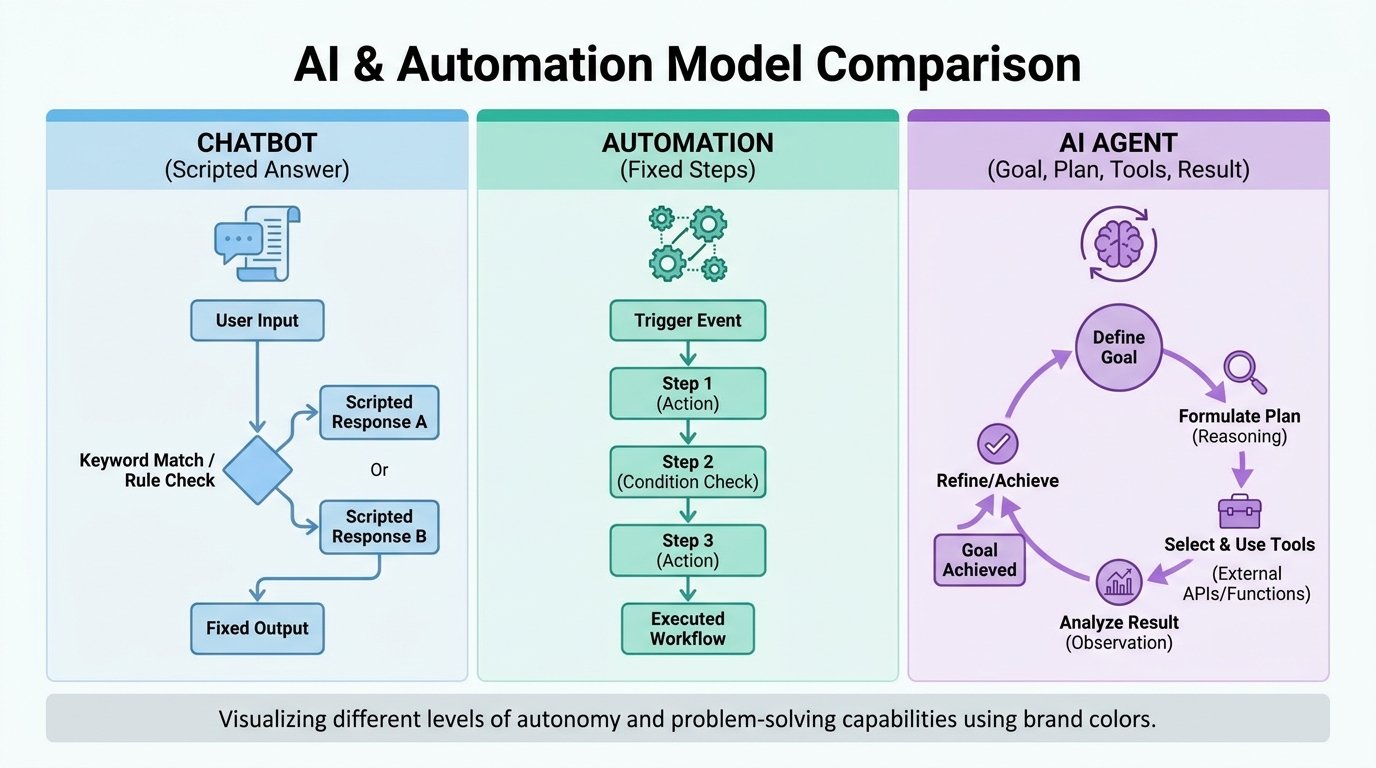
The simplest way to think about it: a chatbot is a vending machine, automation is an assembly line, and an agent is a junior employee. You give the junior employee an outcome (“answer support emails about shipping; escalate anything about refunds”) and a set of rules, and it figures out each individual case. That is genuinely new, and it is why the noise around this topic is so loud.
The adoption numbers tell an honest story of early days. According to the Gartner 2026 CIO and Technology Executive Survey, only 17 percent of organizations have deployed AI agents so far, yet more than 60 percent expect to within two years, the steepest adoption curve of any emerging technology Gartner measures. Translation for a small business: you are not behind, and getting one well-scoped agent working now puts you ahead of most companies of any size.
AI Agents vs Chatbots vs Automation: What Is the Difference?
These three terms get mashed together in marketing, and buying the wrong one wastes money. The difference comes down to who decides the steps: you, a script, or the AI itself.
| Chatbot | Automation | AI Agent | |
|---|---|---|---|
| What it does | Answers questions from a script or knowledge base | Runs the exact steps you defined, every time | Pursues a goal, choosing its own steps and tools |
| Who decides the steps | You, in advance | You, in advance | The AI, within limits you set |
| Example | “What are your hours?” gets the hours | Form submitted, contact created, email sent | Reads a support ticket, checks the order, issues the fix, replies |
| Best for | FAQs and lead capture | Repetitive, predictable processes | Tasks that need judgment on every case |
| Typical small business cost | $0 to $50/mo | $0 to $50/mo | $0 to $100/mo, or pay per result |
Here is the practical buying rule. If your questions are predictable, a chatbot is the cheapest fix, and a specialist can configure one in days; our AI chatbot setup guide covers that path. If your process is identical every time, you want automation, not an agent. Reserve agents for work where every case is slightly different and a human currently has to think about each one.
Types of AI Agents for Business
Agents are specialists, not generalists. The successful deployments we see all pick one of these five lanes and stay in it. Spreading one agent across several lanes is the fastest way to get mediocre results in all of them, so choose the lane attached to your biggest weekly time drain.
Customer Service Agents
The most proven category by far. A support agent reads each incoming message, finds the answer in your help content and order data, resolves what it can, and escalates the rest with full context. This is where per-result pricing was invented, and where the public performance data is strongest. Phone-based versions now exist too: an AI voice agent answers calls, books appointments, and takes messages around the clock; our AI voice agent setup guide covers what those cost to deploy.
Sales Agents
A sales agent watches your inbox and CRM, researches each new lead, drafts a personalized follow-up, and nudges you when a deal goes quiet. The good ones never send without approval; they remove the writing and remembering, and leave the relationship to you. For a small team, the realistic win is response speed: every inquiry gets a thoughtful draft within minutes.
Research Agents
Give a research agent a standing question (“what are competitors charging,” “what changed in my industry this week”) and it searches, reads, compares, and delivers a short brief on schedule. This is the easiest agent type to start with because the worst-case failure is a mediocre report, not an upset customer. Start here if you are nervous: a Monday pricing brief or a weekly competitor summary teaches you how agents think before one ever talks to a customer.
Coding Agents
Coding agents write, test, and fix software with light supervision, and they are the reason developers adopted agents first. For a non-technical owner, the practical version is smaller: an agent that maintains your website tweaks, spreadsheet formulas, and small scripts on request instead of waiting a week for a freelancer.
Marketing Agents
Marketing agents run the repeatable middle of your marketing: turning one idea into platform-specific drafts, scheduling, watching performance, and flagging what to double down on. Treat their output as strong drafts. The businesses that get burned are the ones that let a marketing agent publish unreviewed.
Best AI Agent Platforms in 2026
You do not need an enterprise platform. After testing the realistic options on small business budgets, these six cover every starting point, from a $0 experiment to autonomous customer support. Prices verified in June 2026.
| Platform | Best For | Agent Pricing | Rating | Try It |
|---|---|---|---|---|
| ChatGPT | Your first general agent | Free / From $20/mo | 8.9/10 | Visit |
| Claude | Long documents and careful reasoning | Free / From $20/mo | 8.9/10 | Visit |
| n8n | Custom agents on your own stack | Free self-hosted / Cloud from $20/mo | 8.4/10 | Visit |
| Intercom (Fin) | Autonomous customer support | $0.99 per resolution | 8.2/10 | Visit |
| Zendesk | Helpdesk with AI assist for agents | From $19/agent/mo + AI add-ons | 8.1/10 | Visit |
| Freshdesk | Budget helpdesk with Freddy AI | From $19/agent/mo + AI add-ons | 8.0/10 | Visit |
ChatGPT
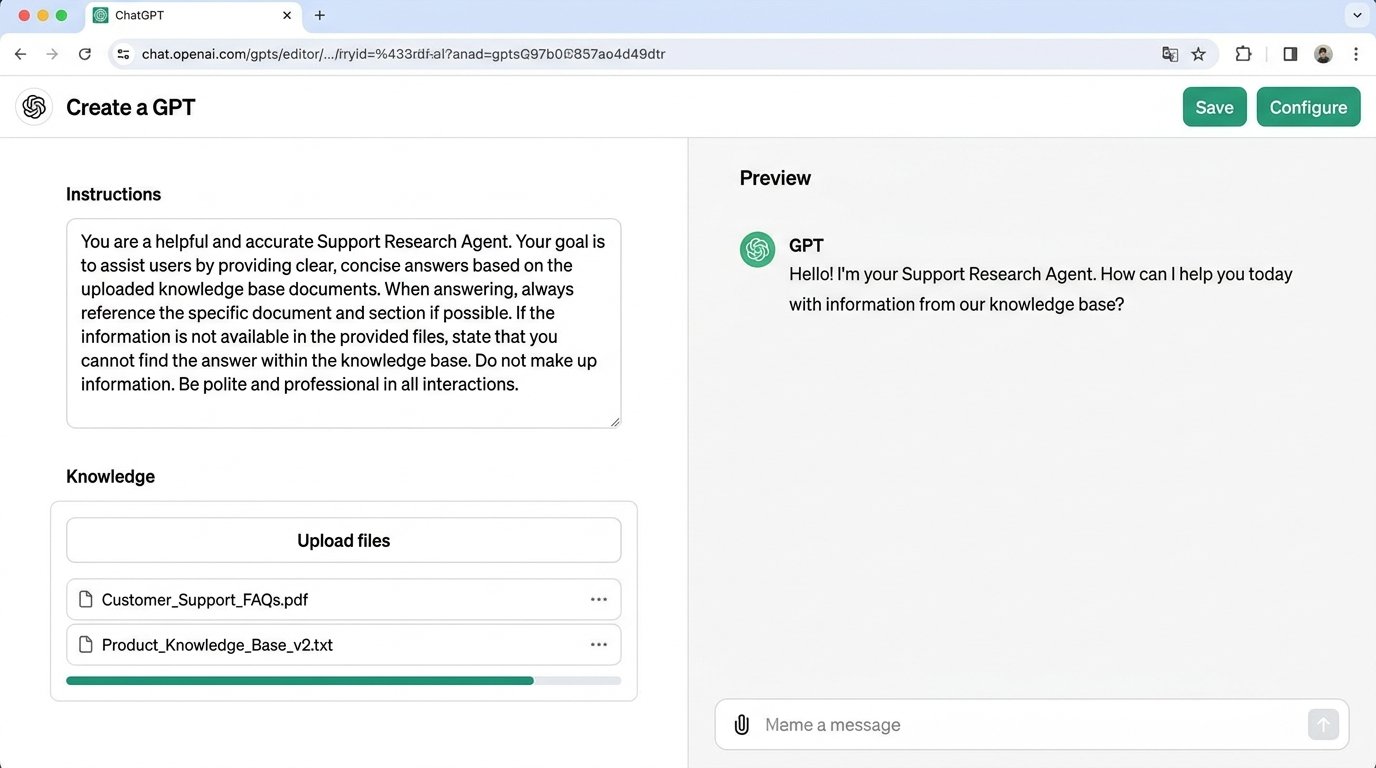
Best First AgentChatGPT is the easiest place for a small business to build its first AI agent. Custom GPTs let you package instructions, your documents, and connected actions into a reusable agent for research, drafting, and analysis, and agent-style task features keep expanding on the $20 Plus plan.
- Custom GPTs: your own scoped agents
- Web research, file analysis, image generation
- Scheduled and multi-step task features
- No technical setup required
Claude
Best for Deep WorkClaude is our pick for agents that read and reason over long material: contracts, reports, policies, and full inboxes. Its Projects feature holds your business context so agent-style tasks stay consistent, and its writing needs noticeably less editing before it reaches a customer.
- Excellent with long documents and context
- Projects keep standing business knowledge
- Careful, low-hallucination reasoning style
- Strong drafting voice for client-facing text
n8n
Best for Custom Agentsn8n is the best platform for custom AI agent workflows that connect to your own tools. Its visual builder includes dedicated AI agent nodes with memory and tool use, so an agent can read your inbox, query your sheet, decide, and act, all inside guardrails you draw.
- Native AI agent nodes with tools and memory
- Connects to your email, CRM, sheets, and APIs
- Per-run pricing keeps complex agents cheap
- Free unlimited self-hosted edition
Intercom
Best Support AgentIntercom’s Fin is the benchmark customer service agent in 2026: it reads each conversation, answers from your help content, takes multi-step actions, and you pay only when it fully resolves the issue. Intercom publishes an average 67 percent resolution rate across 7,000+ customers, and Fin can even run on top of other helpdesks.
- Pay per resolved conversation, $0.99 each
- Multi-step Procedures for real actions
- Works standalone on Zendesk and others
- Voice, email, and chat channels included
What about the traditional helpdesks? Zendesk (from $19/agent/mo) and Freshdesk (from $19/agent/mo) both now sell AI agent capabilities as add-ons on top of seat pricing. Their AI leans toward assisting your human team, suggesting replies and triaging, rather than fully autonomous resolution. If you already live in one of them, adding their AI layer is the low-disruption path; if you are starting fresh and want autonomy, Fin’s pay-per-result model is the cleaner bet.
Real Examples: How Businesses Use AI Agents
Here is what working deployments actually look like at small business scale. These are typical setups we recommend and see in the field, with the numbers kept honest.
The online store that stopped answering “where is my order?” Picture a Shopify store doing 800 support conversations a month, most of them shipping status, returns, and sizing. A support agent connected to the order system resolves the routine majority instantly at $0.99 each; the owner handles the genuinely tricky 30 percent. Cost: roughly $400 to $550 a month at Fin-style rates. Replaced: most of a part-time support hire. If you want this configured properly, our AI customer support setup guide shows what specialists charge and deliver.
The plumber whose phone answers itself. A two-person trade business misses calls all day because hands are busy. An AI voice agent answers every call, books jobs straight into the calendar, captures the address and problem, and texts a summary. Missed-call revenue is the most measurable agent win we know: each rescued booking is plain new money.
The agency with a Monday morning research brief. A marketing consultant runs a scheduled research agent: every Monday at 7 am it checks each client’s industry news, competitor pricing pages, and ad activity, then delivers a one-page brief per client. Two hours of weekly grunt work became a coffee read, and clients think she never sleeps.
The sales follow-up that never forgets. A B2B services firm pipes every inquiry to an agent that researches the company, drafts a tailored reply, and queues it for one-click approval. Nothing sends itself; the human stays in the loop. Average response time fell from next-day to under 15 minutes, which is often the entire reason a deal is won.
How to Set Up Your First AI Agent
The pattern behind every successful first agent is the same: narrow scope, written rules, supervised launch. Here is the six-step version we recommend.
Step 1: Pick one narrow job with a clear success measure. “Handle my support” is a project that fails. “Answer shipping and returns questions from our help docs, escalate everything else” is an agent that works. You should be able to say what “done well” means in one sentence.
Step 2: Write the playbook first. Agents automate documented judgment. Write down how you decide: what a good answer looks like, what must always be escalated, what the agent may never say or do. If you cannot write the rules, the agent cannot follow them.
Step 3: Choose the platform that matches the job. General research or drafting: build a Custom GPT or a Claude Project. Customer support: a per-resolution agent like Fin. Anything that must touch your own systems on a schedule: an n8n agent workflow.
Step 4: Feed it knowledge, grant minimum permissions. Upload your help docs, price list, and policies. Connect only the tools the job needs, read-only where possible. An agent that cannot reach your billing system cannot break your billing system.
Step 5: Run it in draft mode for two weeks. Let the agent propose answers and actions while a human approves each one. You will find the gaps in your playbook fast, and you fix the playbook, not just the individual mistake.
Step 6: Go live narrow, measure, then widen. Switch on autonomy for the cases it handled flawlessly, keep approval on the rest, and review a sample weekly. Expand scope only after a clean month.
Risks and Limitations of AI Agents
Now the part vendors skip. Agents fail in specific, predictable ways, and Gartner expects more than 40 percent of agentic AI projects to be canceled by the end of 2027 over escalating costs, unclear value, and weak risk controls. Industry surveys show the same gap from the other side: most companies that say they have “adopted agents” still do not run any in production. The failures are avoidable if you respect five limits.
Agents confidently get things wrong. An agent will occasionally invent a policy, misread an order, or promise something you do not offer, with perfect confidence. That is why customer-facing agents need a tight knowledge base, forbidden-topics rules, and easy escalation, and why draft mode comes before autonomy.
Costs can run away quietly. Per-resolution and usage-based pricing scales with success and with volume spikes. A viral product or a bot-spam wave can triple a monthly bill. Set spend caps and alerts on day one, not after the first surprise invoice.
Permissions are the real security risk. An agent with access to email, billing, and customer data is a new door into your business. Give minimum permissions, prefer read-only access, keep logs of every action, and never let an early agent send money or delete data unsupervised.
Garbage knowledge in, garbage agent out. Agents answer from what you feed them. Outdated help docs and contradictory policies become confident wrong answers at scale. Cleaning your documentation is unglamorous and is also half the project.
Some work should stay human. Angry customers, judgment calls with legal or money consequences, anything where empathy is the product: route these to people, on purpose, forever. Based on our analysis of failed deployments, most agent projects die from scope, not technology; they tried to automate judgment the business had never written down.
AI Agents + Automation: Building a Complete System
The strongest small business setups are layered, not agent-everything. Automation provides the rails: fixed, reliable workflows that move data the same way every time. Agents sit at the decision points on those rails, handling the steps that need judgment. A support flow might run on automation end to end, with an agent deciding the reply in the middle and a human approving anything about refunds. In practice the layers look like this: automation captures the lead and creates the record, the agent researches the company and drafts the reply, and automation sends the approved version and logs the outcome.
This order matters in practice: businesses that automate first have clean data, documented processes, and connected tools, which is exactly the foundation agents need. Businesses that jump straight to agents hand a thinking machine a messy filing cabinet.
If your processes are not automated yet, start with our Complete Guide to AI Automation for Small Business, then add agents where the rules keep failing.
Hiring an AI Agent Developer
You can build a Custom GPT yourself this afternoon. Hire a developer when the agent must connect to multiple systems, take real actions, run reliably on a schedule, or face customers unsupervised. On Fiverr, custom agent builds run $200 to $2,000, and the tiers are fairly consistent: around $200 to $500 buys a single-purpose agent on one platform with your knowledge wired in; $500 to $1,200 buys a multi-tool agent integrated with your CRM, inbox, or store, with error handling; $1,200 to $2,000 buys complex or voice agents with testing, logging, and a handover document.
Three questions that separate professionals from prompt-sellers: how will the agent handle a case it cannot resolve, what does the error log look like, and what happens when an underlying model or API changes? Walk away from anyone who promises full autonomy on day one or cannot show you a testing plan.
Want Your Agent Built by a Specialist?
Vetted developers on Fiverr design, build, and document custom AI agents for small businesses, from single-task assistants to integrated support and voice agents. Our custom AI agent development guide breaks down the $200 to $2,000 pricing tiers and exactly what to put in your brief.
The Information People Are Looking For
What is an AI agent in business?
An AI agent in business is software given a goal instead of a script: it plans its own steps, uses tools like email and databases, and completes multi-step tasks with minimal supervision. Common examples are customer support agents, research agents, and sales follow-up agents that draft replies for approval.
What is the difference between an AI agent and a chatbot?
A chatbot answers questions from a script or knowledge base; an AI agent pursues an outcome, deciding its own steps and taking actions like checking an order or booking an appointment. If every case follows the same pattern, you need a chatbot or automation; if each case needs judgment, you need an agent.
What is the best AI agent platform for a small business?
ChatGPT is the best starting platform: Custom GPTs let you build a scoped agent in an afternoon for $20 per month. For autonomous customer support, Intercom’s Fin at $0.99 per resolution is the benchmark. For custom agents connected to your own tools, n8n is the strongest choice and is free self-hosted.
How much do AI agents cost for a business?
Simple agents cost $0 to $50 per month using ChatGPT, Claude, or self-hosted n8n. Customer support agents typically charge per result, around $0.99 per resolved conversation. A custom-built agent from a Fiverr developer costs $200 to $2,000 one time, depending on integrations and complexity.
How do businesses use AI agents?
The proven uses are customer support resolution, AI voice agents that answer calls and book appointments, scheduled research briefs, sales follow-up drafting, and marketing content pipelines. Customer service is the most mature category: leading support agents publicly resolve around two-thirds of conversations without a human.
Can AI agents replace employees?
AI agents replace tasks, not whole roles. They reliably absorb routine support replies, data lookup, drafting, and scheduling, which can equal part of a hire’s workload. Judgment calls, relationships, and accountability stay human. The realistic outcome for a small business is doing more without the next hire, sooner.
How do I create an AI agent for my business?
Pick one narrow job with a clear success measure, write the decision rules down, then build it as a ChatGPT Custom GPT, a Claude Project, or an n8n agent workflow. Feed it your documents, grant minimum permissions, run it in draft mode for two weeks, and only then allow autonomy on the cases it handles flawlessly.
Are AI agents safe to use for business?
AI agents are safe when scoped tightly: minimum permissions, read-only access where possible, spend caps, action logs, and human approval for anything involving money or sensitive data. The known risks are confident wrong answers, runaway usage costs, and over-broad system access, and all three are manageable with basic controls.
Do I need coding skills to build an AI agent?
No. ChatGPT Custom GPTs and Claude Projects are built with plain instructions and uploaded documents, and n8n provides visual agent nodes without code. Coding only becomes useful for deep custom integrations, which is exactly when hiring a Fiverr agent developer for $200 to $2,000 makes sense.
AI agents are real, useful, and earlier in their story than the headlines suggest. The winning move for a small business in 2026 is not the boldest agent; it is the narrowest one: a single, well-scoped agent doing one job under supervision. Build that this month, let it earn autonomy, and you will be ahead of the 83 percent still watching from the sidelines.