HubSpot vs Pipedrive (2026): Which CRM Is Right for You?
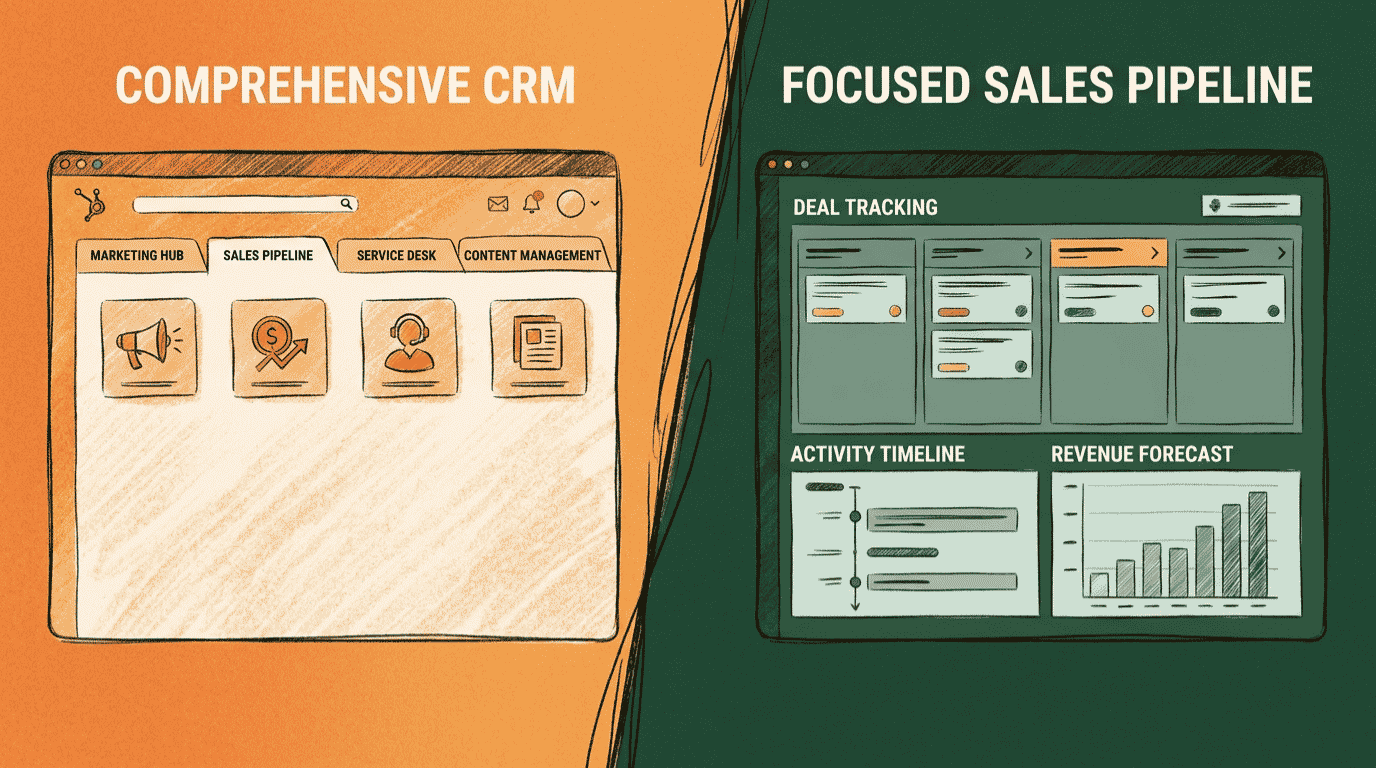
HubSpot vs Pipedrive comes down to one big question: do you want an all-in-one platform or a focused sales CRM? HubSpot bundles marketing, sales, and service into one system with a free CRM to start. Pipedrive is a leaner, pipeline-first tool built purely for sales teams.
Both are excellent, but they suit very different businesses. I have tested both with real pipelines, so this guide is based on hands-on use, not feature lists.
Below, we compare ease of use, features, pricing, and which CRM fits your team.
Quick Answer
Choose HubSpot if you want an all-in-one platform for marketing, sales, and service, plus a genuinely free CRM to start. Choose Pipedrive if you want a focused, affordable sales CRM with a visual pipeline, starting at $14 per user per month. For pure sales teams on a budget, Pipedrive is leaner; for all-in-one growth, HubSpot wins.
This comparison is part of our complete AI tools buyer’s guide. Read the full guide for a framework on how to choose the right software for your business.
HubSpot vs Pipedrive at a Glance
Here is the short version before we dig in. Both are top-rated CRMs, but they are built for different goals. HubSpot was named the number 2 Sales Product on G2 in 2025.
| Tool | Best For | Starting Price | Free Plan | Our Rating |
|---|---|---|---|---|
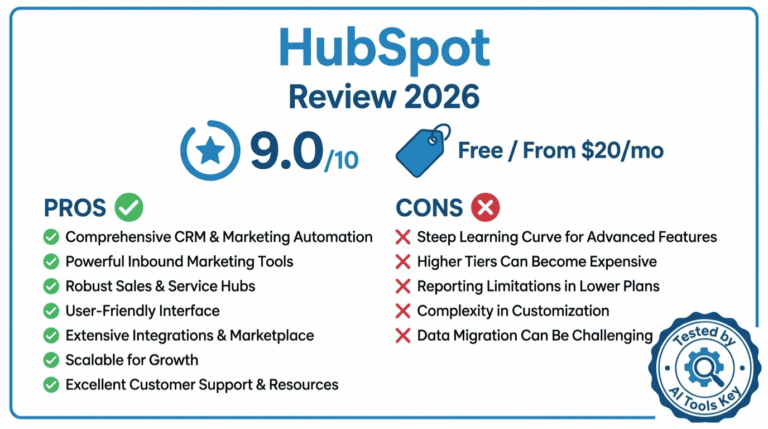
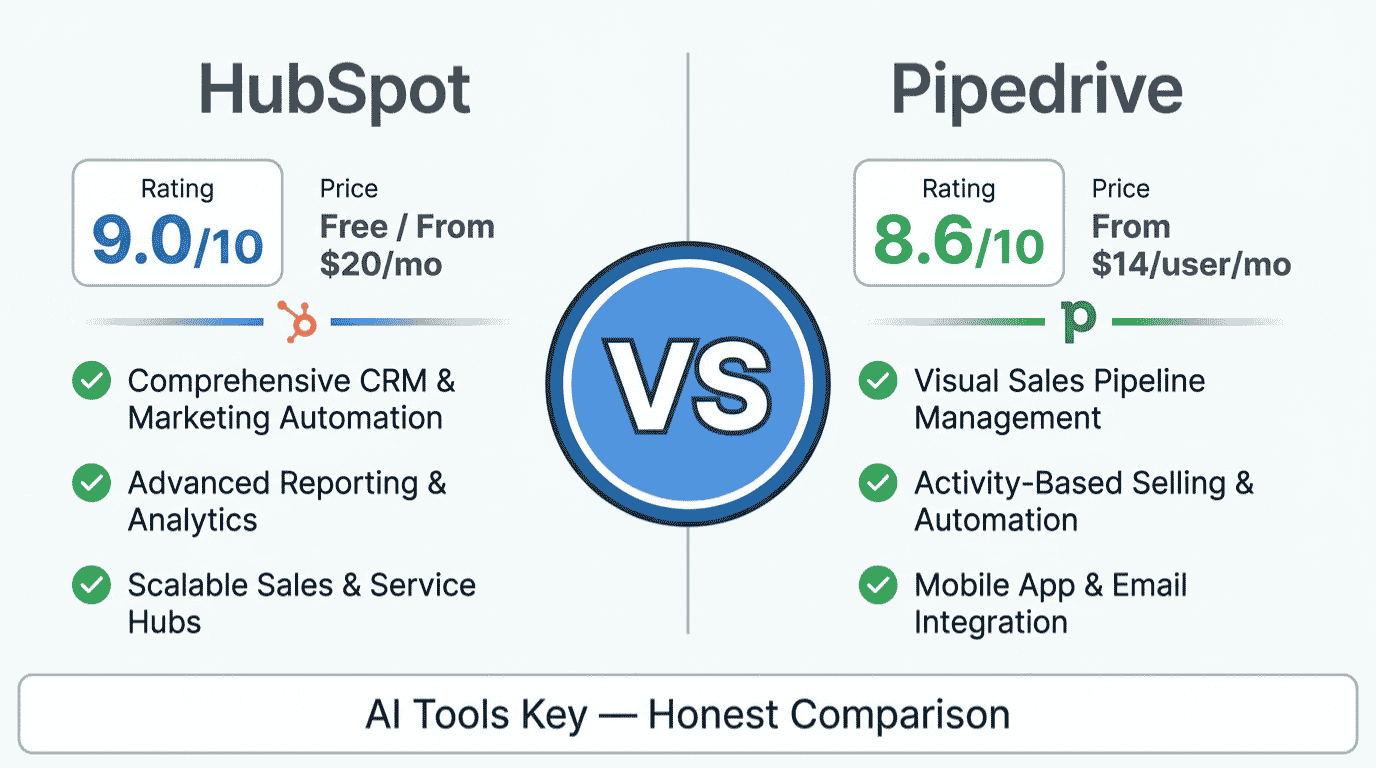
| HubSpot | All-in-one CRM and marketing | Free / $20/seat/mo | Yes | 9.0/10 |
| Pipedrive | Focused, visual sales pipeline | $14/user/mo | No (14-day trial) | 8.6/10 |
Try HubSpot Free Try Pipedrive
HubSpot is the better all-in-one platform for marketing, sales, and service, while Pipedrive is the better focused, affordable sales CRM. Let us look at why.
What Is HubSpot?
HubSpot is an all-in-one customer platform that unifies marketing, sales, service, content, and operations around a single CRM. It is built to manage the entire customer journey in one place.
Its biggest draw for small businesses is the forever-free CRM. You can manage contacts, deals, and tasks at no cost, which makes it a popular first step up from spreadsheets.
HubSpot also leans heavily into AI and reporting, with built-in email marketing, lead capture, and cross-channel analytics. You can see how it rates on G2.
The trade-off is breadth. There is a lot to learn, and costs climb quickly once you move past the Starter tier.
What Is Pipedrive?
Pipedrive is a sales-focused CRM, often described as built by salespeople, for salespeople. Its entire design centers on one job: helping sales teams close more deals.
The heart of Pipedrive is its visual, drag-and-drop pipeline. Deals appear as cards you move through stages, giving reps an instant, at-a-glance view of every deal in progress.
It is simpler and more intuitive than HubSpot, and it starts cheaper per user. Pipedrive includes unlimited contacts and deals on every plan. You can read user reviews on G2 too.
The trade-off is scope. Pipedrive does sales brilliantly, but it is not a full marketing and service platform, and it has no free plan.
HubSpot vs Pipedrive: The Core Difference
If you remember one thing from this comparison, make it this: HubSpot is a broad, all-in-one platform, while Pipedrive is a focused sales specialist.
HubSpot wants to be your single system for marketing, sales, and support, with the CRM tying it all together. It rewards businesses that want everything connected in one place.
Pipedrive wants to be the best possible tool for managing and closing deals, and nothing more. It rewards sales teams that value simplicity and speed over breadth.
These two are genuine competitors, so most businesses pick one. The right choice depends on whether you want an all-in-one platform or a lean sales engine. Get that single decision right, and the rest tends to follow naturally.
Ease of Use and Sales Pipeline: Which Wins?
For pure sales pipeline management and simplicity, Pipedrive is the winner.
Pipedrive’s visual pipeline is the cleanest in the category. Reps can drag deals between stages, log activities, and see exactly what to do next without wading through extra features. Most teams are productive within a day.
HubSpot is also user-friendly and offers a guided tour, but it carries far more features. That power is great, yet it means more to learn before you are using the platform to its full potential.
So if a fast, focused sales workflow is your priority, Pipedrive wins. If you want one platform to grow into, HubSpot’s extra depth is worth the learning curve.
Features and All-in-One Tools: Which Wins?
Flip the question to breadth of features, and HubSpot pulls clearly ahead.
HubSpot bundles tools that Pipedrive simply does not include: full email marketing, landing pages, built-in VoIP calling, live chat, content management, and customer service features, all connected to the same CRM.
Pipedrive focuses on sales and relies on its marketplace add-ons for extras like lead generation or web visitor tracking, which cost more on top of your plan.
Picture a small business running a product launch. On HubSpot, the same platform sends the marketing emails, captures leads on a landing page, routes hot leads to sales, and logs every support ticket afterward, all tied to one contact record. On Pipedrive, you would handle the deals beautifully but plug in separate tools for the email campaign and the support side. That single-platform convenience is HubSpot’s biggest advantage.
For a deeper look at platforms that combine sales and marketing, see our best AI CRM software roundup. If you want one tool to run your whole go-to-market motion, HubSpot’s breadth is hard to beat.
AI and Reporting: Which Wins?
Both platforms have added AI, but HubSpot offers more of it across more places.
HubSpot uses AI for content creation, email drafting, predictive insights, and cross-channel reporting that spans marketing and sales. Its analytics are genuinely powerful for businesses that live by their numbers.
Pipedrive has useful AI too, including deal summaries, an AI writing assistant, and AI-powered reports, but the scope is narrower and more sales-specific.
HubSpot has deeper AI and reporting across more channels than Pipedrive. For sales-only insights, Pipedrive is plenty; for company-wide analytics, HubSpot leads.
Here is a balanced look at where HubSpot stands overall.
Where HubSpot wins
- A genuinely useful forever-free CRM to start
- All-in-one: marketing, sales, service, and more in one place
- Deeper AI and cross-channel reporting than most CRMs
- Built-in email marketing, VoIP, and lead capture tools
- One Starter seat unlocks every hub at once
Where HubSpot falls short
- Costs escalate sharply at Professional and above
- Onboarding fees apply on higher tiers
- So many features that fully using them takes time
- Free plan has limits, like around 1,000 contacts and HubSpot branding
Pricing Compared
This is where the two diverge in an important way: one has a free plan, and the other does not.
HubSpot’s CRM is free forever, while Pipedrive has no free plan, only a 14-day trial. On paid plans, though, Pipedrive starts cheaper per user. Here is how they line up.
| What | HubSpot | Pipedrive |
|---|---|---|
| Free plan | Yes (forever-free CRM) | No (14-day trial) |
| Entry paid | Starter, $20/seat/mo | $14/user/mo |
| Focus | All-in-one platform | Sales pipeline |
| Built-in marketing and email | Yes | Limited (add-ons) |
| Visual sales pipeline | Yes | Yes (its specialty) |
| Cost at scale | Escalates sharply | More predictable |
One note on HubSpot: Pipedrive starts at $14 per user per month; HubSpot’s Starter platform is $20 per seat per month. HubSpot’s free CRM is the cheapest way to begin, but its Professional tier jumps to roughly $90 or more per seat, plus onboarding fees. Annual billing saves on both.
HubSpot vs Pipedrive: Which Is Actually Cheaper?
Let us put real numbers on it, because the answer flips depending on your stage.
To start, HubSpot is cheaper, because its free CRM costs nothing while Pipedrive requires a paid plan after the trial. But for a paid sales tool, Pipedrive is leaner: a 3-person team pays about $42 a month on Pipedrive’s entry plan, versus $60 a month on HubSpot’s $20 Starter seats.
The cost result
For a free start, HubSpot wins with its forever-free CRM. For the cheapest paid sales CRM, Pipedrive is more affordable at $14 per user versus HubSpot’s $20 per seat. The big watch-out is HubSpot’s Professional tier, where per-seat costs and onboarding fees climb fast. Pick HubSpot for a free all-in-one start, Pipedrive for predictable, sales-focused value.
So the honest answer is this: HubSpot is cheaper to begin and broader in scope, while Pipedrive is the more affordable, predictable choice for a dedicated sales team.
Don’t want to set it up yourself? Configuring a CRM, importing data, and building pipelines correctly takes time. Our specialists set up either platform for you, from deal stages to automation. Explore our AI CRM setup and integration service, or browse the full AI services directory.
Hire a CRM Expert on FiverrWho Should Use Each Tool?
Still deciding? It often comes down to the kind of business you run.
HubSpot suits companies that generate inbound leads, want their marketing, sales, and support working from the same data, and plan to scale. If you want one connected platform for the whole customer journey, it is built for you.
Pipedrive suits small to mid-sized sales teams that just want to manage their pipeline and close deals, without paying for marketing or service tools they will not use. If sales execution is your focus, Pipedrive is a natural fit.
If you are a budget-conscious sales team, Pipedrive is the leaner pick. If you want a free starting point and room to grow into marketing and service, HubSpot is the smarter long-term home.
Not Sure Which One Fits? Try the Head-to-Head Picker
Reading a comparison is one thing; getting a clear answer is another. Answer three quick questions below about what you need, your team, and your priorities, and the picker returns our recommended winner with current pricing. Nothing you tap is saved or sent anywhere.
HubSpot vs Pipedrive: Which Is Right for You?
3 quick questions, about 20 seconds, no email required.
The Verdict: Which Should You Choose?
After testing both with real pipelines, here is our straight answer. There is no single winner, because each CRM is built for a different kind of business.
Choose HubSpot if
You want an all-in-one platform for marketing, sales, and service, you generate inbound leads, and you value a free CRM with room to scale. HubSpot’s breadth, AI, and reporting make it the better long-term home for connected growth.
Choose Pipedrive if
You want a focused, affordable sales CRM with a clean visual pipeline, and you do not need marketing or service tools. Pipedrive’s simplicity, low per-user cost, and sales focus make it the better pick for dedicated sales teams.
Our rating weighs five factors: features, ease of use, pricing value, support, and integrations. You can read exactly how we test and rate every tool on our editorial guidelines page. Both score highly; they simply serve different businesses.
Comparing other platforms too? Our ActiveCampaign vs GetResponse breakdown is a useful next read if marketing automation is also on your list.
HubSpot and Pipedrive Alternatives
These two are not your only options. Depending on your goal, a few alternatives are worth a look.
If you want a CRM combined with powerful marketing automation, ActiveCampaign is a strong choice. For a budget-friendly platform with a built-in sales CRM and email tools, Brevo is worth testing. You can compare the top picks in our best AI email marketing tools roundup, or browse the full AI tools directory.
Prefer to Have Your CRM Set Up for You?
Even the best CRM only pays off when it is configured around your sales process. If you would rather skip the setup, you do not have to do it alone.
Done-for-you setup: Our vetted experts configure HubSpot or Pipedrive, import your data, build your pipeline stages, and connect your tools. Explore our AI CRM setup and integration service, or turn leads into customers with our AI sales funnel creation service.
Hire a CRM Expert on FiverrThe Information People Are Looking For
Is HubSpot better than Pipedrive?
It depends on your needs. HubSpot is better as an all-in-one platform for marketing, sales, and service, with a free CRM and deeper AI. Pipedrive is better as a focused, affordable sales CRM with a simpler pipeline. For end-to-end growth, choose HubSpot; for pure sales execution, choose Pipedrive.
Is Pipedrive cheaper than HubSpot?
On paid plans, yes. Pipedrive starts at $14 per user per month, while HubSpot’s Starter platform is $20 per seat per month. However, HubSpot has a forever-free CRM, so it is cheaper to start. Pipedrive becomes the more predictable value for dedicated sales teams once you are paying.
Does Pipedrive have a free plan?
No. Pipedrive does not offer a free plan, only a 14-day free trial with no credit card required. HubSpot, by contrast, has a forever-free CRM. If a permanent free option is important to you, HubSpot is the clear winner, though Pipedrive’s paid plans start at a lower per-user price.
Is HubSpot CRM really free?
Yes, HubSpot’s core CRM is free forever, covering contact management, deals, tasks, forms, and basic email. The limits are around 1,000 contacts, HubSpot branding on emails, and no advanced automation. It is a genuine free tool, not a trial, and a popular first CRM for startups and small businesses.
Which is better for a small business?
It depends on your focus. HubSpot suits small businesses that want marketing, sales, and support in one platform with a free start. Pipedrive suits small sales teams that want an affordable, easy pipeline and nothing extra. Budget-focused sales teams often prefer Pipedrive; growth-focused teams often prefer HubSpot.
Is Pipedrive easier to use than HubSpot?
Yes, for sales. Pipedrive’s visual, drag-and-drop pipeline is simpler and faster to learn, and most teams are productive within a day. HubSpot is also user-friendly but has far more features, so it takes longer to master. For a focused, low-friction sales workflow, Pipedrive wins on ease of use.
Some links in this article are affiliate links. If you sign up through them, we may earn a commission at no extra cost to you. This never affects our ratings or recommendations. See our full affiliate disclosure for details.