
The best AI tools for small business in 2026 include ChatGPT for everyday assistance, Jasper AI for marketing content, Semrush for SEO, GetResponse for email marketing, and Zapier for automation. Together, those five tools cover the work that eats most of a small business owner’s week: writing, getting found on Google, talking to customers, and repetitive admin.
This guide is the result of hands-on testing, not a list scraped from press releases. After personally testing more than 50 AI tools across 10+ categories for AI Tools Key, we rated every tool on a weighted 10-point scale: features (30 percent), ease of use (25 percent), pricing value (20 percent), support quality (15 percent), and integrations (10 percent). Below, you will find our top picks in every major category, real pricing, a starter stack you can launch this month, and honest guidance on when free tools are enough.
Quick Answer
The best AI tools for small business in 2026 are ChatGPT ($20/month) for everyday work, Jasper AI (from $39/month) for marketing content, Semrush (from $139.95/month) for SEO, GetResponse (free plan, paid from $19/month) for email, and Zapier (free plan available) for automation. Most owners should start with ChatGPT plus one specialist tool.
What Are AI Tools and Why Small Businesses Need Them
AI tools are software applications that use artificial intelligence to complete business tasks that normally require human time and skill. For a small business, that means drafting emails and blog posts, designing graphics, answering customer questions, scoring leads, editing video, and automating repetitive workflows, usually for $10 to $50 per month per tool.
The shift is no longer theoretical. A 2026 QuickBooks survey found that 68 percent of U.S. small businesses now use AI regularly, up from 48 percent in mid-2024. Transaction-level research from the JPMorgan Chase Institute tells the same story from actual spending data: small business AI adoption more than tripled between 2023 and the end of 2025, growing from 5.2 percent to 17.7 percent of firms, with most new adopters entering at the $20 to $30 per month price point.
Why does this matter to you? Because your competitors are not hiring more people. They are buying back hours. An owner who uses ChatGPT to draft proposals, an AI design tool to produce social graphics, and an automation platform to move data between apps can realistically reclaim 5 to 15 hours every week. That is time you can spend on sales, customers, or simply not working at 11 pm.
The catch is choice overload. Hundreds of products now market themselves as “AI for small business,” and many are thin wrappers around the same underlying models, repackaged at premium prices. This guide exists to cut through that noise with tested, rated recommendations.
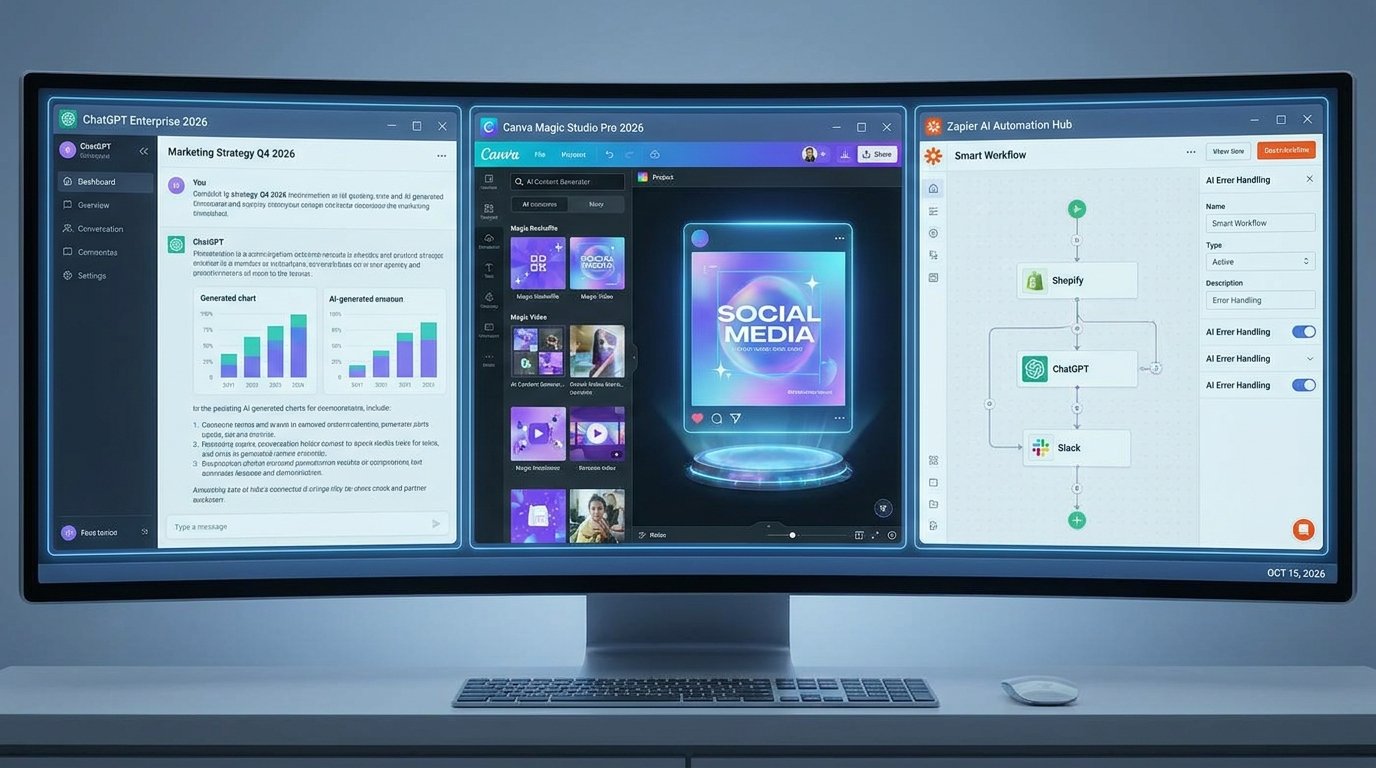
The Best AI Tools for Small Business at a Glance
Here are our top-rated AI tools for small business across all 10 categories, based on our weighted testing methodology. Every rating below comes from hands-on use, and every price was verified in June 2026. You can browse all of our category roundups on our Best AI Tools hub.
| Tool | Category | Starting Price | Rating | Free Plan or Trial | Try It |
|---|---|---|---|---|---|
| Semrush | AI SEO | From $139.95/mo | 9.2/10 | Yes | Visit |
| Jasper AI | AI Writing | From $39/mo | 9.0/10 | Yes | Visit |
| HubSpot | AI CRM | Free / From $20/mo | 9.0/10 | Yes | Visit |
| ChatGPT | AI Assistant | Free / From $20/mo | 8.9/10 | Yes | Visit |
| Canva Pro | AI Design | Free / From $10/mo | 8.8/10 | Yes | Visit |
| GetResponse | AI Email Marketing | Free / From $19/mo | 8.6/10 | Yes | Visit |
| ManyChat | AI Chatbots | Free / From $15/mo | 8.6/10 | Yes | Visit |
| Zapier | AI Automation | Free / From $19.99/mo | 8.5/10 | Yes | Visit |
| ClickUp | AI Project Management | Free / From $7/user/mo | 8.1/10 | Yes | Visit |
| Synthesia | AI Video | Free / From $18/mo | 8.0/10 | Yes | Visit |
Full ranked list: Best AI Tools for Small Business
The 10 Essential AI Tool Categories for Small Business
Most small businesses do not need 30 tools. They need one good tool in each category that actually matters to their work. Here are the 10 categories we cover at AI Tools Key, with our tested top pick and runner-ups in each: writing, SEO, email marketing, CRM and sales, automation, chatbots and customer service, video, design, project management, and general AI assistants.
1. AI Writing Tools
AI writing tools turn a rough idea into finished marketing copy: blog posts, product descriptions, ads, emails, and social captions. For a small business without a copywriter on staff, this is usually the category with the fastest, most obvious payoff.
Jasper AI
Top PickJasper AI is the best AI writing tool for small businesses that produce marketing content every week. Its Brand Voice feature learns how your company sounds, so output needs less editing than generic chatbots.
- Brand Voice training on your own content
- Dozens of marketing-specific templates
- SEO mode for optimized blog drafts
- Team collaboration and campaign workflows
On a tighter budget, Copy.ai (7.5/10) offers a genuinely useful free tier for short-form marketing copy. And whatever drafts a tool produces, Grammarly (8.3/10) remains the best final polish layer, catching tone and clarity issues before anything goes out to customers.
Go deeper: our ranking of the best AI writing tools for small business, the full Jasper AI review and Jasper AI pricing breakdown, and our Copy.ai review. Find your fit: take the 60-second AI Writing Tool Finder quiz.
2. AI SEO Tools
AI SEO tools help you find the keywords your customers search for, optimize your pages to rank, and monitor competitors. If organic traffic drives any part of your revenue, this category pays for itself faster than almost any other.
Semrush
Top PickSemrush is the best AI SEO platform for small businesses that depend on search traffic, and it earned the highest rating of any tool we have tested at 9.2/10. It combines keyword research, site audits, rank tracking, and AI-assisted content optimization in one place.
- Keyword and competitor research at depth
- AI-assisted content writing and optimization
- Technical site audits with fix priorities
- Rank tracking and backlink analysis
If $139.95 per month is too steep, Surfer SEO (8.4/10, from $99/mo) focuses purely on on-page content optimization and is excellent for bloggers who already have a keyword plan.
Go deeper: our ranking of the best AI SEO tools, the full Semrush review and Semrush pricing breakdown, and our Surfer SEO review. Find your fit: take the 60-second AI SEO Tool Finder quiz.
3. AI Email Marketing Tools
Email still delivers some of the best returns in small business marketing, and AI now handles the hard parts: writing campaigns, picking send times, and building automated sequences that nurture leads while you sleep.
GetResponse
Top PickGetResponse is the best all-in-one AI email marketing platform for small businesses. The AI campaign generator builds complete emails and automation flows from a short prompt, and the platform bundles landing pages and webinars that competitors charge extra for.
- AI email and subject line generator
- Visual marketing automation builder
- Landing pages and signup forms included
- Webinar hosting on higher plans
Worth knowing: in our testing, ConvertKit (Kit) actually scores slightly higher overall at 8.7/10 and is our pick for creators, coaches, and newsletter businesses. We recommend GetResponse as the small business default because of its broader all-in-one feature set at the entry price.
Go deeper: our ranking of the best AI email marketing tools, plus our GetResponse review and ActiveCampaign review. Find your fit: take the 60-second AI Email Marketing Tool Finder quiz.
4. AI CRM and Sales Tools
An AI CRM keeps every lead, conversation, and deal in one place, then uses AI to draft follow-ups, summarize calls, and tell you which prospects deserve attention today. If leads are slipping through cracks in your inbox, this is your category.
HubSpot
Best Free PlanHubSpot offers the most generous free CRM in the industry, and its built-in AI assistants now draft emails, summarize contact history, and generate reports. It grows with you from solo founder to a 20-person team without switching platforms.
- Free CRM with contacts, deals, and pipelines
- AI email drafting and call summaries
- Marketing, sales, and support hubs in one
- Huge integration ecosystem
If you want something leaner and purely sales-focused, Pipedrive (8.6/10, from $14/user/mo) is faster to learn and its AI sales assistant is excellent at telling you which deal to work next.
Go deeper: our ranking of the best AI CRM software for small business and our full HubSpot CRM review. Find your fit: take the 60-second AI CRM & Sales Tool Finder quiz.
5. AI Automation Tools
Automation tools connect the apps you already use and move data between them automatically: new form submission becomes a CRM contact, a Slack alert, and a welcome email, with zero manual copying. Recent research shows the typical AI-using small business now runs a median of five AI tools, and automation is the glue that makes a stack like that work together.
Zapier
Top PickZapier is the easiest way for a non-technical owner to automate work across thousands of apps. In 2026 you can describe an automation in plain English, and Zapier builds the workflow for you, complete with AI steps that summarize, categorize, or draft text along the way.
- Connects thousands of business apps
- Plain-English AI workflow builder
- AI steps inside automations
- Free plan with 100 tasks per month
Power users who want more control at a lower running cost should look at n8n (8.4/10), an automation platform with a generous free option that handles complex, multi-step AI workflows beautifully.
Go deeper: our ranking of the best AI automation tools and our full Zapier review. Find your fit: take the 60-second AI Automation Tool Finder quiz.
6. AI Chatbot and Customer Service Tools
AI chatbots answer customer questions instantly, 24/7, on your website and social channels. For a small team, that means fewer interrupted afternoons and no more leads lost because nobody replied to an Instagram DM until the next morning.
ManyChat
Top PickManyChat is the best chatbot platform for businesses that get customers through Instagram, Facebook, or WhatsApp. Its AI handles comments and DMs automatically, captures contact details, and pushes qualified leads into your email list or CRM.
- Instagram, Facebook, and WhatsApp automation
- AI replies to comments and DMs
- Lead capture flows with integrations
- Generous free plan to start
For website live chat with an AI support agent that learns from your help content, Tidio (8.2/10, free plan available) is our pick for e-commerce stores. And if you would rather have a professional configure the whole thing, our AI chatbot setup service guide explains what to expect and what it costs.
Go deeper: our ranking of the best AI chatbots for small business and our full Tidio review. Find your fit: take the 60-second AI Chatbot Finder quiz.
7. AI Video Tools
AI video tools let you produce professional videos without a camera, studio, or editor. Type a script, pick a presenter, and export a finished video for training, marketing, or social content.
Synthesia
Top PickSynthesia turns text into presenter-led video using realistic AI avatars and natural voiceovers in dozens of languages. It is ideal for explainer videos, onboarding, and product walkthroughs that would otherwise cost hundreds per video to produce.
- Realistic AI avatars and voices
- Text to video in minutes
- Templates for training and marketing
- No camera or editing skills needed
If your goal is repurposing rather than presenting, Pictory AI (7.6/10, from $19/mo) automatically turns blog posts and long recordings into short, captioned social clips.
Go deeper: our ranking of the best AI video generators. Find your fit: take the 60-second AI Video Tool Finder quiz.
8. AI Design and Advertising Tools
AI design tools give non-designers a way to produce on-brand graphics, ads, and marketing materials in minutes. This is the category where a $10 subscription most visibly replaces work you used to outsource.
Canva Pro
Best ValueCanva Pro delivers the highest return per dollar of any AI design tool we have tested. Magic Studio writes copy, generates images, removes backgrounds in one click, and resizes a single design for every platform automatically.
- Magic Write and AI image generation
- One-click background removal
- Resize one design for every channel
- Massive template and brand kit library
If paid ads are your growth channel, AdCreative.ai (7.4/10, from $21/mo) generates and scores dozens of ad variations so you can test creatives without a designer on retainer.
Go deeper: our ranking of the best AI design tools for small business and our full Canva Pro review. Find your fit: take the 60-second AI Design Tool Finder quiz.
9. AI Project Management Tools
AI project management tools keep tasks, deadlines, and documents organized, then add AI on top: summarizing updates, writing task descriptions, and answering questions about your own projects.
ClickUp
Top PickClickUp packs tasks, docs, goals, and chat into one workspace, and its built-in AI summarizes threads, drafts updates, and automates routine project admin. The free plan is strong enough for most solo owners and very small teams.
- Tasks, docs, and goals in one place
- AI summaries and task drafting
- Templates for common workflows
- Strong free plan
If your business runs on documents and wikis more than task boards, Notion AI (8.4/10) is the better fit: it answers questions from your own notes and turns meeting scribbles into clean action lists.
Go deeper: our ranking of the best AI project management tools.
10. General AI Assistants
General AI assistants are the Swiss Army knife of this entire list. One subscription handles writing, research, brainstorming, analysis, spreadsheets, and image generation. If you only adopt one AI tool this year, it should come from this category.
ChatGPT
Best First ToolChatGPT is the single most valuable first AI tool for small businesses in 2026. It drafts anything, analyzes spreadsheets and documents, generates images, and answers questions about your business problems in plain language. The free plan is useful; the $20 Plus plan removes the limits that matter.
- Drafting, research, and analysis in one chat
- File and spreadsheet analysis
- Image generation included
- Custom GPTs for repeat workflows
Two strong alternatives: Claude (8.9/10) matches ChatGPT overall and is our preference for long documents and natural writing quality, while Microsoft Copilot (8.7/10) is the obvious choice if your business already lives in Word, Excel, and Outlook.
Go deeper: our guide on how to use ChatGPT for business and our ChatGPT vs Claude for business comparison. Find your fit: take the 60-second AI Assistant Finder quiz.
How to Choose the Right AI Tool
The biggest mistake we see small business owners make is starting with the tool instead of the problem. A subscription you do not use is just a new monthly cost. Here is the five-question framework we use in every review:
1. What task costs you the most time each week? Pick your single most painful, repetitive task. That defines your category. Writing customer emails points to an assistant or email platform; invisible Google rankings point to SEO.
2. What is your honest monthly budget? Most categories have excellent options between $10 and $50 per month. Decide the number before you see the pricing pages, not after.
3. Does it connect to what you already use? A tool that talks to your email platform, CRM, and website saves far more time than a slightly smarter tool that lives on an island.
4. Can you get value in the first week? Test the free plan or trial on one real task. If you cannot produce something useful within seven days, the learning curve will quietly kill your usage.
5. Will it still fit in 12 months? Check the next pricing tier up. Some tools get dramatically more expensive exactly when your business starts growing.
Want the full decision framework, including red flags to avoid and a printable evaluation checklist? Read our complete AI Tools Buyer’s Guide: How to Choose the Right AI Software.
AI Tools by Industry
The right AI stack depends heavily on what your business actually does. A real estate agent and a Shopify store owner should not buy the same five tools. Here is how we would build a starter stack for five common small business types.
AI Tools for YouTube Creators
Creators get the most from a content pipeline: ChatGPT for video ideas, titles, and scripts, Canva Pro for thumbnails that earn clicks, and Pictory or Synthesia for turning long videos into short clips and faceless content. Add ClickUp as a simple content calendar and you have a one-person production studio.
Full guide: Best AI Tools for YouTube Creators
AI Tools for Real Estate Agents
Agents win with speed and follow-up. ChatGPT writes listing descriptions and client emails in seconds, Canva Pro produces flyers and social posts, ManyChat captures leads from Instagram and Facebook automatically, and HubSpot or Pipedrive makes sure no buyer inquiry goes cold over a busy weekend.
Full guide: Best AI Tools for Real Estate Agents
AI Tools for Shopify and E-commerce Stores
Store owners should focus on product copy, support, and ads. Copy.ai or Jasper handles product descriptions at scale, Tidio answers pre-sale questions around the clock, AdCreative.ai generates ad variations worth testing, and Zapier moves orders and customer data between your store, email platform, and spreadsheets.
Full guide: Best AI Tools for Shopify Store Owners
AI Tools for Bloggers and Content Creators
Bloggers live and die by search traffic. Jasper or ChatGPT drafts, Semrush or Surfer SEO optimizes for keywords that can actually rank, Grammarly polishes, and ConvertKit (Kit) turns readers into an email audience you own.
Full guides: Best AI Tools for Bloggers and Content Creators, Best AI Tools for Content Creation, and How to Use AI for Content Creation
AI Tools for Teachers and Educators
Educators save hours with ChatGPT for lesson plans, quizzes, and differentiated materials, Canva for worksheets and presentation slides, Synthesia for explainer videos students can rewatch, and Notion AI to keep curriculum notes organized and searchable.
Full guide: Best AI Tools for Teachers and Educators
More business types: Best AI Tools for Freelancers and Agencies and Best AI Tools for Small Business Accounting and Invoicing.
AI Automation: The Next Step
Individual AI tools save minutes. Connecting them saves hours. Once you run three or more tools, the manual work shifts from doing tasks to moving information between apps: copying a lead from a form into your CRM, then into your email platform, then into a spreadsheet. Automation removes that entire layer.
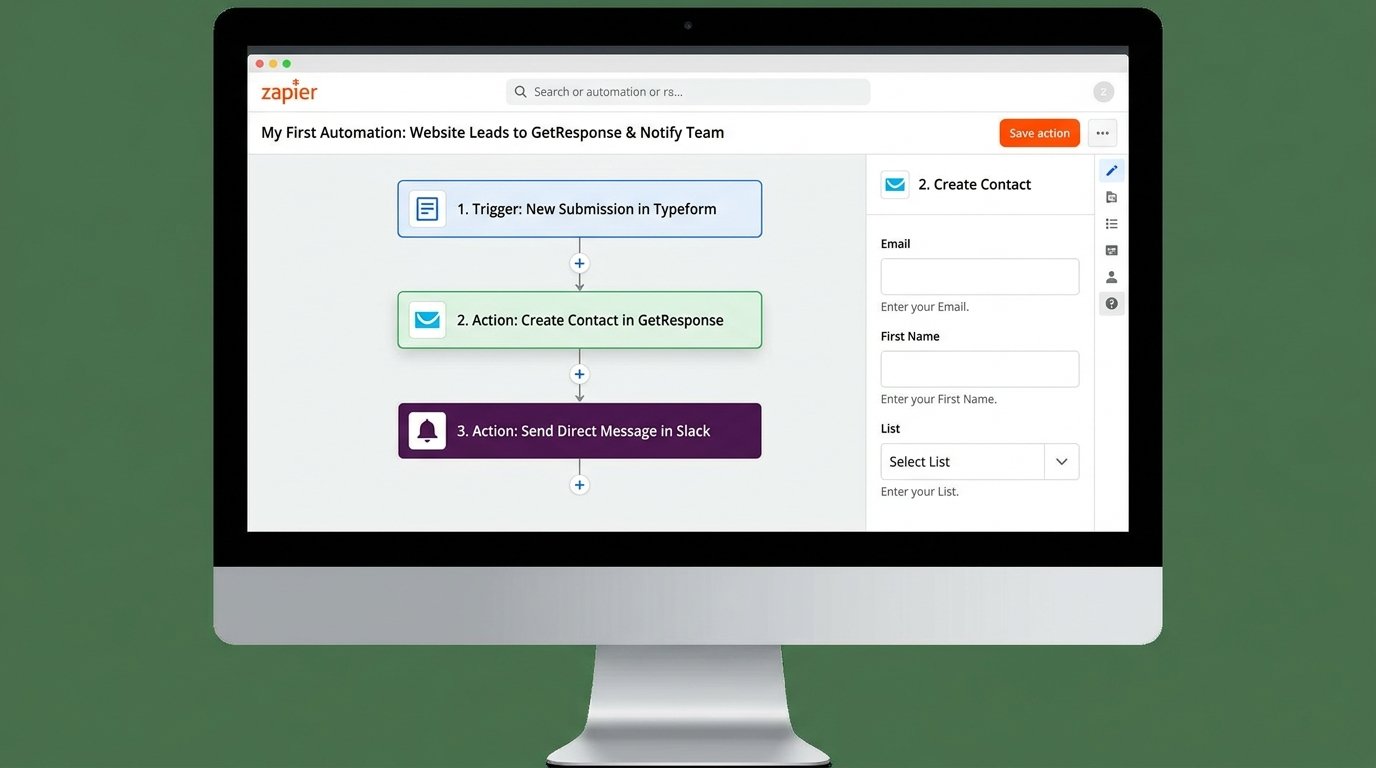
A simple example: a visitor fills out your website form. Zapier instantly creates the contact in HubSpot, adds them to a GetResponse welcome sequence, asks an AI step to summarize what they asked for, and posts that summary to your phone. You did nothing, and the lead got a response within one minute instead of one day.
You can build automations like this yourself on a free Zapier or n8n plan in an afternoon. If your workflows are more complex, or you simply want it done right the first time, a specialist can set up your entire system; our AI workflow automation setup guide covers typical costs and what to ask for.
Ready to go deeper? Our Complete Guide to AI Automation for Small Business walks through the exact workflows worth automating first, with real examples.
What Are AI Agents?
An AI agent is software that works toward a goal with minimal supervision: it plans steps, uses multiple tools, makes decisions, and acts on your behalf. Where an AI tool drafts one email when prompted, an AI agent can monitor your inbox, research each sender, draft replies, and flag only the messages that genuinely need you.
Agents are the most exciting frontier in business AI, and also the most oversold. In 2026, simple agents already work well for research, customer support triage, and routine scheduling. Fully autonomous “run my business” agents do not exist yet, no matter what the ads say. Our honest advice: master tools and automation first. Agents multiply whatever systems you already have, including messy ones.
Curious what is actually possible right now? Read our Complete Guide to AI Agents for Business for realistic use cases, costs, and setup paths.
Free vs Paid AI Tools: What Small Businesses Should Know
Free AI tools in 2026 are genuinely good, which surprises many owners. ChatGPT, Canva, HubSpot, Zapier, GetResponse, and ManyChat all offer free plans that handle real work, not just demos. For a brand new business, you can assemble a working AI stack for $0 and validate that you will actually use it.
The limits show up predictably. Free tiers cap usage (Zapier’s 100 tasks per month disappear fast once automations work), restrict features (brand kits, automation steps, AI credits), add branding to what customers see, and usually limit you to one user. Free general assistants also throttle you to slower or older models during busy hours, exactly when you need them.
Our rule from testing dozens of free tiers: free plans are for validation, paid plans are for operation. Use the free version for two to four weeks on real tasks. Track roughly how many hours it saves you.
The smart pattern is mixed: pay for the one or two tools at the center of your work, and keep free plans everywhere else until they pinch. Paying for everything on day one is how owners end up with $300 of monthly subscriptions and $50 of actual usage.
Start free: our ranking of the best free AI tools for business.
Getting Started: Your First AI Tool Stack
If you are starting from zero, ignore the hundreds of options and launch with this four-tool stack. Based on our testing across more than 50 tools, this combination covers content, design, customer communication, and automation for a typical small business, and you can run it for $30 to $70 per month.
| Tool | Job in Your Business | Start With | Monthly Cost |
|---|---|---|---|
| ChatGPT Plus | Writing, research, analysis, daily assistant | Plus plan | $20 |
| Canva Pro | Social graphics, flyers, presentations | Pro plan | From $10 |
| GetResponse | Email list, newsletters, welcome automation | Free plan | $0, later from $19 |
| Zapier | Connecting everything, repetitive admin | Free plan | $0, later from $19.99 |
Roll it out over 30 days so each tool becomes a habit instead of a forgotten login. Week one: use ChatGPT for one real task every single day. Week two: rebuild your three most-used designs as Canva templates. Week three: set up your email list and one automated welcome email. Week four: build your first Zap connecting your website form to your email list.
Our Verdict
A complete AI starter stack for a small business costs $30 per month on day one, and under $70 fully upgraded. Start with ChatGPT Plus today, add Canva Pro this week, and let the free plans of GetResponse and Zapier earn their upgrades. The owners who win with AI are not the ones with the most tools; they are the ones who actually use four.
Start With ChatGPTNeed Help Choosing or Setting Up Your AI Stack?
If you would rather have an expert map your tools, set up your automations, and train your team, vetted AI consultants on Fiverr handle exactly this for small businesses. See what to expect and typical costs in our AI business consultant guide.
More AI Tool Guides and Reviews
Every guide below goes deeper on one part of this page. Start with the category closest to your biggest weekly time drain.
Best-of Roundups
- Best AI Tools for Small Business
- Best Free AI Tools for Business
- Best AI Writing Tools for Small Business
- Best AI Tools for Content Creation
- Best AI SEO Tools
- Best AI Email Marketing Tools
- Best AI CRM Software for Small Business
- Best AI Chatbots for Small Business
- Best AI Video Generators
- Best AI Design Tools for Small Business
- Best AI Project Management Tools
In-Depth Reviews
- Jasper AI Review
- Copy.ai Review
- Semrush Review
- Surfer SEO Review
- GetResponse Review
- ActiveCampaign Review
- HubSpot CRM Review
- Canva Pro Review
Pricing Guides
How-To Guides
AI Tools by Business Type
- Best AI Tools for YouTube Creators
- Best AI Tools for Real Estate Agents
- Best AI Tools for Freelancers and Agencies
- Best AI Tools for Shopify Store Owners
- Best AI Tools for Bloggers and Content Creators
- Best AI Tools for Teachers and Educators
- Best AI Tools for Small Business Accounting and Invoicing
The Information People Are Looking For
What is the best AI tool for a small business?
ChatGPT is the best first AI tool for most small businesses in 2026. The free plan handles writing, research, and analysis, and ChatGPT Plus costs $20 per month. Once you have a daily AI habit, add a specialist such as Semrush for SEO or GetResponse for email marketing.
How much do AI tools cost for small businesses?
Most small business AI tools cost between $10 and $50 per month per tool. Many, including ChatGPT, Canva, Zapier, and GetResponse, offer free plans. A complete starter stack covering content, design, email, and automation typically runs $30 to $70 per month, far less than hiring for those tasks.
Which AI tools should a small business start with?
Start with four tools: ChatGPT Plus ($20/month) as your general assistant, Canva Pro (from $10/month) for design, GetResponse (free plan available) for email marketing, and Zapier (free plan available) for automation. This stack covers content, visuals, customer communication, and repetitive admin for as little as $30 per month.
Do AI tools really save small businesses time?
Yes. AI-using small businesses commonly report saving 5 to 15 hours per week on writing, customer replies, and admin. Research from the JPMorgan Chase Institute and QuickBooks shows adoption rising sharply because owners see measurable returns. The biggest savings come from automating one painful, repetitive workflow first.
Are free AI tools good enough for a small business?
Free AI tools are good enough for testing and light use. ChatGPT, Canva, Zapier, and GetResponse all offer genuinely useful free plans. However, free tiers cap usage, limit features, and add branding. Once a tool saves you even two hours a week, the $10 to $50 monthly upgrade pays for itself.
What is the difference between AI tools and AI agents?
An AI tool completes a task when you prompt it, such as drafting an email. An AI agent works toward a goal with less supervision, planning steps, using multiple tools, and acting on your behalf. Most small businesses should master AI tools and automation before investing in AI agents.
How do I choose the right AI tool for my business?
Start with the problem, not the tool. Identify your most time-consuming weekly task, shortlist two or three tools built for that job, and test each free plan or trial for one real week. Compare results on output quality, ease of use, and price, then commit to one tool.
Do I need technical skills to use AI tools for small business?
No. The best AI tools for small business are built for non-technical owners. ChatGPT works through plain conversation, Canva is drag and drop, and Zapier builds automations from plain-English descriptions. If you can use email and social media, you can use every tool recommended in this guide.
AI will not run your small business for you, and anyone promising that is selling something. What it will do, today, is hand you back hours every week for the price of a few lunches. Pick one tool from this guide, use it on one real task tomorrow, and build from there. That is the whole secret.